
2 de 14
Fases da Excitação

Até um tempo relativamente recente, nós sabíamos muito pouco a respeito das respostas fisiológicas sexuais. Masters and Johnsons foram os primeiros a estudar as mudanças fisiológicas durante a estimulação sexual durante a década de 50 e 60.
Sua pesquisa tornou possível uma descrição mais específica dos processos típicos durante o coito. Subsequentemente a estes achados, Kaplan (Abnormal, 414-1979) especificou outro estágio anterior ao excitamento referido como "fase do desejo", que descreve o interesse e prontidão sexual de uma pessoa.
A fase do desejo ocorre depois que um indivíduo vê uma pessoa atraente ou em reação a uma insinuação que a faz pensar em sexo. As fantasias sexuais podem ocorrer na ausência de qualquer insinuação sexual.
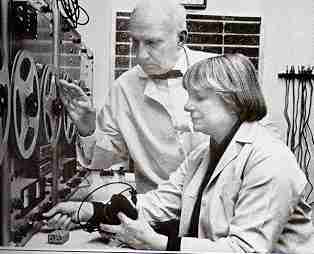 William Masters e Virginia Jonhson, os pioneiros da pesquisa sexual. |
Masters e Johnson desenvolveram métodos e equipamentos e usaram medidas fisiológicas para monitorar voluntários adultos envolvidos em atividade sexual. Sua técnica incluía medições simples de partes anatômicas durante diferentes fases da estimulação, eletrodos intrauterinos para medir contrações uterinas, registro eletrocardiográfico para monitorar a taxa e nível das contrações cardíacas, assim como equipamento para medir a respiração e pressão sanguínea. Dados foram coletados durante a masturbação, assim como durante o coito artifical e natural. As propriedades ópticas de pênis de plástico utilizados para o coito artifical permitiram a observação e registro de respostas fisiológicas intravaginais. |
Until relatively recently, we knew little about sexual physiological responses. Masters and Jonhnson were the first to study physiological changes during sexual stimulation during the 1950s and 1960s. Their research has made possible much more specific description of the typical processes during coitus. Subsequent to these findings, Kaplan (Abnormal, 414- 1979) specified another stage prior to excitement or arousal phase referred to as "desire phase", which describes the person's interest in and radiness for sexual activity. The desire phase occurs after the individual sees an attractive person or in reaction to some cue that makes him or her think of sex. Sexual fantasies may also occur in the absence of any sexual cues.
Masters and Jonhnson developed methods and equipment and used physiological measures to monitor adult volunteers engaging in sexual activity.
Their techniques included simple measurement of anatomical parts during different phases of stimulation, intrauterine electrodes to measure uterine contractions, electrocardiograph tracing to monitor rate and level of cardiac contractions, as well as equipment to measure respiration and blood pressure. Data were collected during masturbation as well as during natural and artificial coitus. The optical properties of plastic penises used for artificial coitus allowed observation and recording of intravaginal physiological responses.
Back to the first page of this article
2 of 14
Author: Dr. Silvia Helena Cardoso, PhD. Psychobiologist, master and doctor in Sciences by the University of São Paulo and post doctoral fellowship by the University of California, Los Angeles. Invited Professor and Associate Researcher of the Center for Biomedical Informatics, State University of Campinas (Unicamp), Brazil. Email: cardoso@nib.unicamp.br
Center for Biomedical Informatics
State University of Campinas, Brazil
Copyright 1997 State University of Campinas